How to Read a Tire Size
A tire size like 235/55R19 101H looks like a code because it is one — every number and letter tells you a specific measurement or rating. Here's what each part means, in order.
Look up your factory tire sizeTire Size Breakdown
| Code segment | Example | What it means |
|---|---|---|
| First number | 235 | Tire width in millimeters, measured sidewall to sidewall |
| Number after the slash | 55 | Aspect ratio — sidewall height as a percentage of the width |
| Letter | R | Construction type — R means radial, the standard on nearly all modern tires |
| Number after the letter | 19 | Wheel diameter in inches the tire is built to fit |
| Number after a space | 101 | Load index — the maximum weight the tire can safely carry |
| Final letter | H | Speed rating — the maximum sustained speed the tire is rated for |
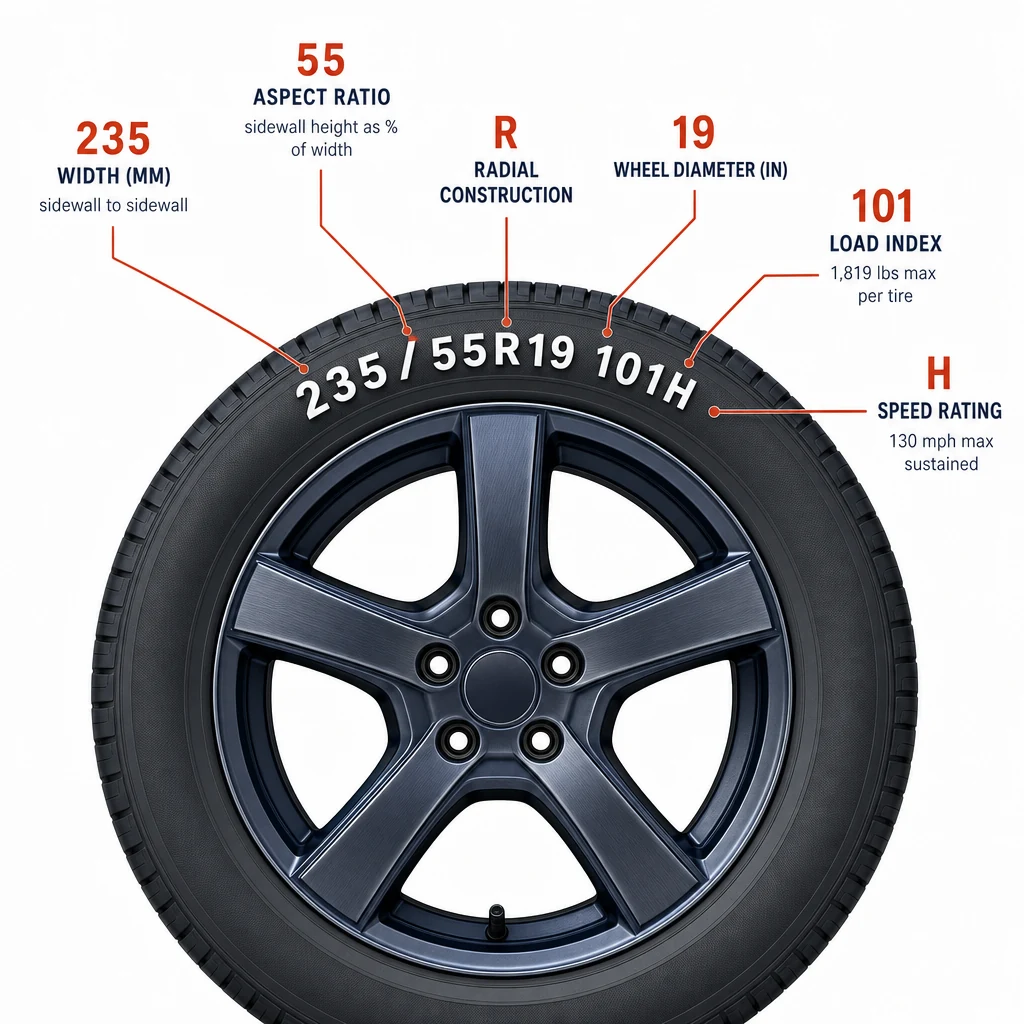
What Each Number Actually Means
Width (235). This is the tire's width in millimeters, measured at the widest point from sidewall to sidewall — not the tread's contact patch on the road. A higher number means a wider tire.
Aspect ratio (55). This is the tire's sidewall height, expressed as a percentage of the width. A 235/55 tire has a sidewall that's 55% as tall as the tire is wide (about 129mm in this example). Lower aspect ratios mean shorter, stiffer sidewalls — common on performance-oriented vehicles. Higher ratios mean taller sidewalls, which typically ride softer.
Construction (R). Radial construction has been the industry standard since the 1970s — the internal cords run radially (perpendicular to the direction of travel) rather than diagonally. You will occasionally see a "D" for diagonal/bias-ply construction on some trailer and specialty tires, but for passenger vehicles, R is essentially universal.
Wheel diameter (19). This is the diameter, in inches, of the wheel the tire is designed to mount on — not the tire's own overall diameter. A 235/55R19 tire fits a 19-inch wheel.
Load index (101). This number corresponds to a maximum weight rating per tire, taken from a standardized load index chart. A load index of 101 corresponds to 1,819 lbs per tire. This matters most for trucks, SUVs, and anyone towing — going below your vehicle's required load index isn't just a spec mismatch, it's a real safety issue.
Speed rating (H). A letter rating corresponding to the tire's maximum sustained speed under controlled conditions. H is rated for 130 mph. These ratings exist to certify the tire's construction and heat tolerance at speed — most drivers will never approach the rated limit, but the rating still reflects the tire's overall build quality and heat resistance.
Where to Find Your Tire Size
Your tire size is molded directly into the sidewall of your current tires — look for the sequence of numbers and letters described above. It's also listed on a sticker inside the driver's side doorjamb (visible when the door is open), and in your vehicle's owner's manual.
If you'd rather skip decoding your current tires altogether, look up your exact factory tire size by year, make, model, and trim instead — no sidewall-squinting required.
Metric vs. Standard: Why Tire Sizes Use Millimeters and Inches
One common point of confusion: tire sizes mix unit systems. Width and sidewall height are in millimeters, but wheel diameter is in inches. This isn't an error — it reflects the tire industry's international standardization history, where different measurements were locked in at different points and never fully unified. It's normal, and every tire size follows the same mixed-unit pattern.
Frequently Asked Questions
What does the "P" or "LT" at the start of some tire sizes mean?
A "P" prefix (e.g., P235/55R19) indicates a P-metric tire, designed for passenger vehicles. "LT" indicates a Light Truck tire, built with reinforced construction for higher load capacity — common on trucks and heavy-duty SUVs. No letter prefix at all typically indicates a Euro-metric sizing, which is dimensionally similar to P-metric but calculated slightly differently for load index.
Can I put a different size tire on my car than what came from the factory?
Sometimes, within limits — but going outside the factory-recommended range can affect your speedometer accuracy, ABS/traction control calibration, and handling. If you’re considering a size change, check your vehicle’s specific fitment options rather than guessing.
What's the difference between aspect ratio 55 and aspect ratio 65?
A lower aspect ratio (like 55) means a shorter sidewall relative to the tire’s width — generally sportier handling with a firmer ride. A higher aspect ratio (like 65) means a taller sidewall — generally a softer ride with more cushioning, common on trucks and comfort-oriented sedans.
Where is the tire size on my specific vehicle?
It varies by trim and model year even within the same vehicle. Look up your exact vehicle to see the confirmed factory size rather than relying on a generic guess.